
- Introduction -
When developing a printed swimwear collection, choosing the right printing method is not simply a technical decision.
It can directly affect:
- How the artwork appears on the finished swimwear
- Whether the main pattern remains visible
- The seamless transition between the print and seams and patchwork areas
- The overall visual effect of the design
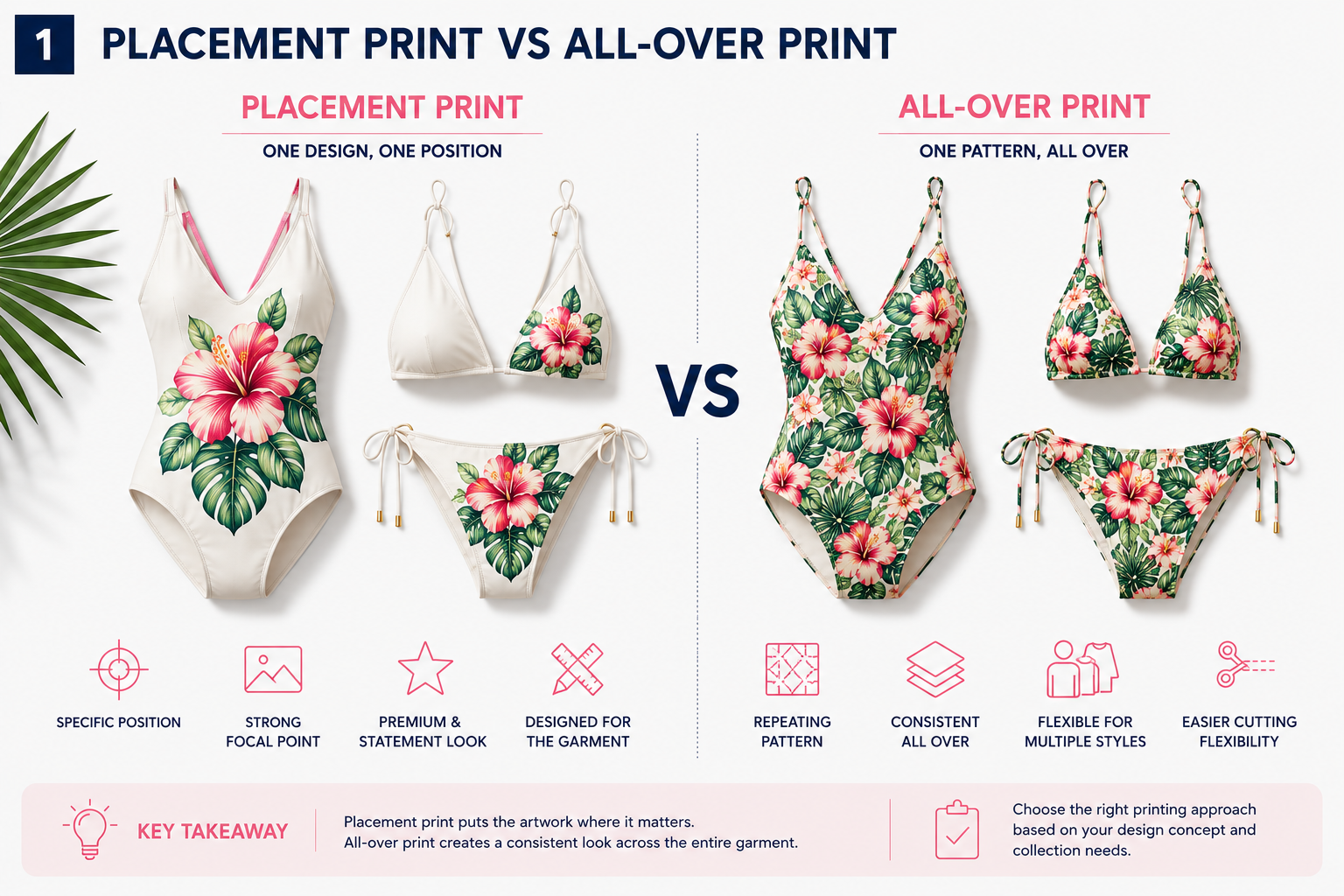
Two of the most common approaches are placement print and all-over print.
While both can create beautiful results, they are designed for different purposes.
What Is Placement Print?
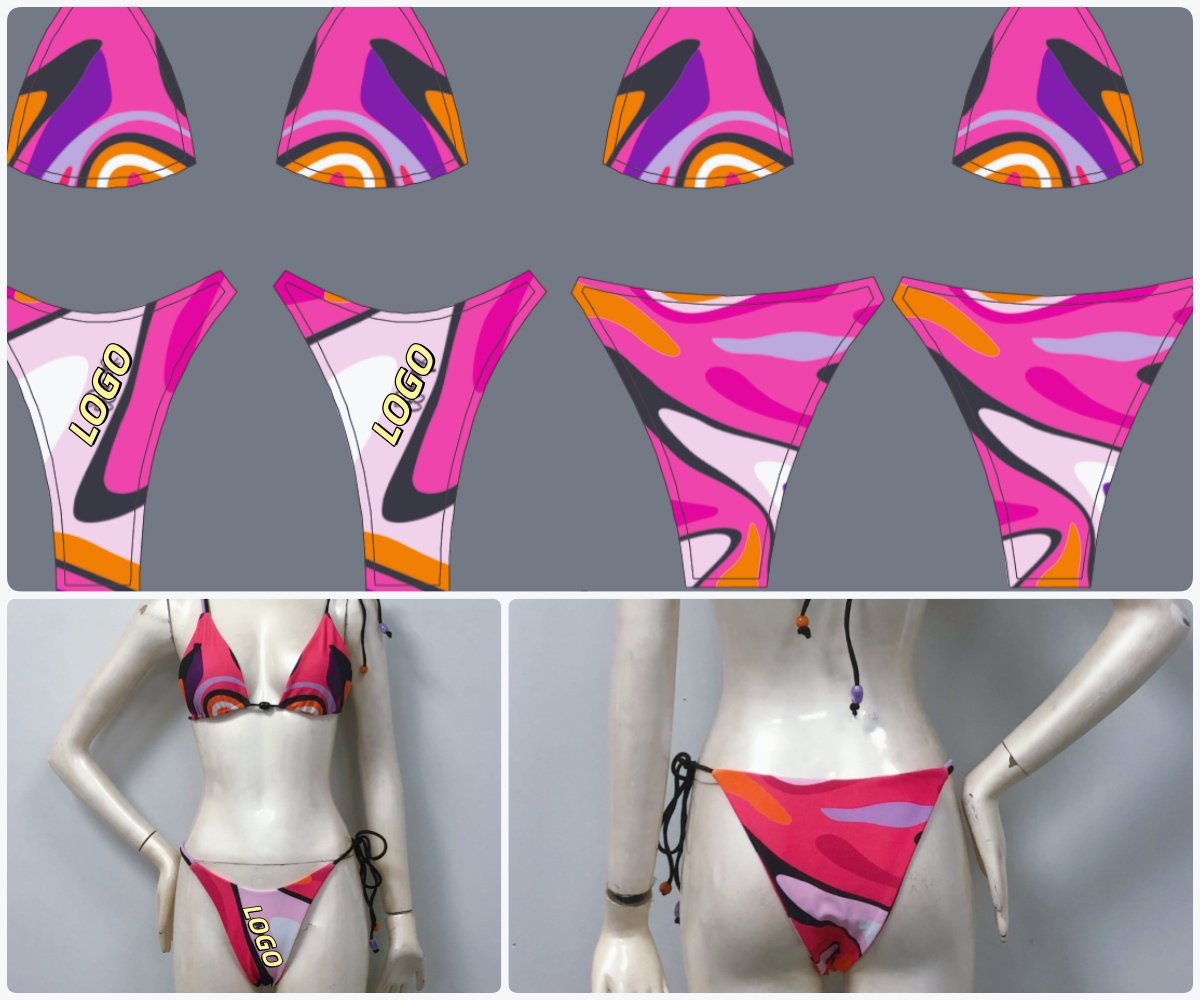
A placement print is designed for a specific position on the garment.
For example:
- A large flower centered on the bust
- A logo positioned on the front
- A graphic placed on the side of a one-piece
- A specific motif positioned on the hip
The artwork is developed with the garment pattern in mind.
The goal is not simply to print a design onto fabric.
The goal is to make sure the artwork appears in the intended position after the fabric is cut and the garment is assembled.
What Is All-Over Print?
An all-over print uses a repeating pattern across the fabric.
Common examples include:
- Floral prints
- Animal prints
- Tropical prints
- Geometric patterns
- Abstract prints
The artwork repeats across the fabric, which means the exact position of each individual motif is generally less important.
This makes all-over printing a practical choice for designs where the overall pattern is more important than one specific focal point.
Placement Print vs All-Over Print
| Placement Print | All-Over Print | |
|---|---|---|
| Main focus | Specific motif or position | Overall pattern |
| Design control | High | Moderate |
| Artwork | Usually designed for a specific garment | Repeating artwork |
| Pattern relationship | Closely connected to garment pattern | More flexible |
| Best for | Statement designs | Repeating patterns |
| Production consideration | Alignment is important | Cutting is generally more flexible |
- When Should You Choose Placement Print? -
1. When the Position of the Artwork Matters
If the artwork contains a clear focal point, placement printing gives the designer greater control.
For example, if a large flower is intended to sit at the center front, an all-over print may not guarantee that result.
The motif could be cut through a seam or appear partially on another panel.
Placement printing allows the artwork to be positioned intentionally.
2. When You Want the Print to Become Part of the Garment Design
Some prints are designed specifically around the shape of the garment.
The artwork may be:
- Centered on the design body
- Symmetrically distributed on two pieces of fabric
- Fits the curve of the bust
- Positioned to create a visual effect on the waist
In these situations, the print is not simply a surface decoration.
It becomes part of the swimwear design.
3. When You Have a Large Statement Artwork
Large-scale artwork usually benefits from placement printing.
For example:
- A large illustration
- A detailed artwork
- A central graphic
- A large-scale floral pattern
With an all-over print, the artwork may be randomly cut during production.
With placement printing, the designer has much greater control over what the customer sees on the finished garment.
- When Should You Choose All-Over Print? -
1. When the Pattern Itself Is the Main Design
If the visual impact comes from the overall pattern rather than one specific motif, all-over printing is usually the more natural choice.
Examples include:
- Leopard print
- Small floral print
- Tropical leaves
- Repeating geometric designs
- Abstract patterns
The pattern can continue naturally across the garment.
2. When One Print Needs to Work Across Multiple Styles
An all-over print can be easier to apply across different products.
The same print may be used on:
- Triangle bikinis
- Bandeau tops
- Bikini bottoms
- One-piece swimsuits
- Cover-ups
Because the pattern repeats, the artwork does not need to be redesigned for every individual garment panel.
NIX SWIM Insight: The Same Print May Need Different Solutions
A print should not be evaluated separately from the garment it will be used on.
This is one of the most important things we consider during swimwear development.
The same artwork can create completely different results depending on the garment style.
For example:
A repeating floral pattern may work perfectly on a bikini with relatively simple panels.
However, if the same artwork is used on a one-piece swimsuit with:
- Multiple seams
- Curved seams
- A large front area
- A central focal point
The artwork may need to be repositioned or redesigned.
The printing method should follow the design intention and the garment construction—not the other way around.
This is why we recommend evaluating the print together with the actual garment pattern before finalizing production.
Why Print Artwork Should Be Checked Before Sampling
One common mistake is to finalize the print artwork first and only consider the garment construction later.
This can create problems such as:
- The main pattern being cut through a seam
- The print appearing off-center
- Different pieces of fabric appear visually mismatched
- The artwork appearing too large or too small
- Important details disappearing after cutting
A print that looks perfect on a flat digital file may not produce the same result on a three-dimensional garment.
This is why reviewing the artwork together with the pattern before sampling can save time and reduce unnecessary revisions.
How to Choose the Right Printing Method
Before finalizing your artwork, ask:
- Is there a specific focal point?
If yes, consider placement print.
- Does the pattern need to repeat naturally?
If yes, all-over print may be more suitable.
- Will the design be used across different styles?
An all-over print may offer greater flexibility.
- Does the artwork need to align with specific garment panels?
Placement printing may provide better control.
- Are there important details that cannot be cut through?
The artwork and pattern should be reviewed together before production.
NIX SWIM Insight
At NIX SWIM, we encourage new brands to treat trends as inspiration rather than a checklist.
A focused collection built around a few well-executed ideas will often outperform a collection that tries to follow every trend at once.
- Final Thoughts -
Placement print and all-over print are not simply two different printing techniques.
They create different design possibilities.
Placement print provides greater control over where the artwork appears.
All-over print provides flexibility and consistency across the fabric.
The right choice depends on the artwork, garment style, pattern construction, and desired final effect.
NIX SWIM Insight
A successful print design is not only about creating beautiful artwork. It is about making sure that artwork still looks right after it becomes a real garment.
That is why print development should always consider the relationship between:
Artwork → Pattern → Cutting → Construction → Finished Garment
The earlier these elements are considered together, the more likely the final product will reflect the original design concept.